

Table of Contents
- What AI Threat Detection for Warehouses Actually Does
- How AI Warehouse Security Systems Work in Practice
- Warehouse Intrusion Detection and Access Control
- Real-Time Hazard Monitoring: Spills, Obstacles, and Unsafe Behavior
- Collision Prevention for Forklifts and Autonomous Mobile Robots
- AI Video Analytics for Warehouses: Detection Accuracy and False Alarms
- Warehouse Safety Monitoring: Reducing Incident Risk and Injury
- Implementation, Privacy, and Audit Trails
- Frequently Asked Questions
Last Updated: October 12, 2026
What AI Threat Detection for Warehouses Actually Does
AI threat detection for warehouses is a proactive security system that uses computer vision and radar sensors to identify dangerous situations before they become incidents.
The core idea: your existing IP cameras become intelligent sensors that analyze what’s happening instead of recording hours of footage you’ll never watch.
AI threat detection changes that equation: the system doesn’t get tired or miss a weapon in a corner or a forklift collision about to happen.
The technology works with your current infrastructure, no expensive camera replacements, no forced cloud migration.
AI threat detection transforms passive video surveillance into an active defense system that catches threats in real time, reduces false alarms, and works with infrastructure you already own.
How AI Warehouse Security Systems Work in Practice
Computer Vision and Radar-Based Detection
The system uses two complementary sensing technologies. Computer vision analyzes video from your IP cameras to recognize objects, people, and behaviors, weapons, restricted-zone entries, and unsafe actions like running near machinery.
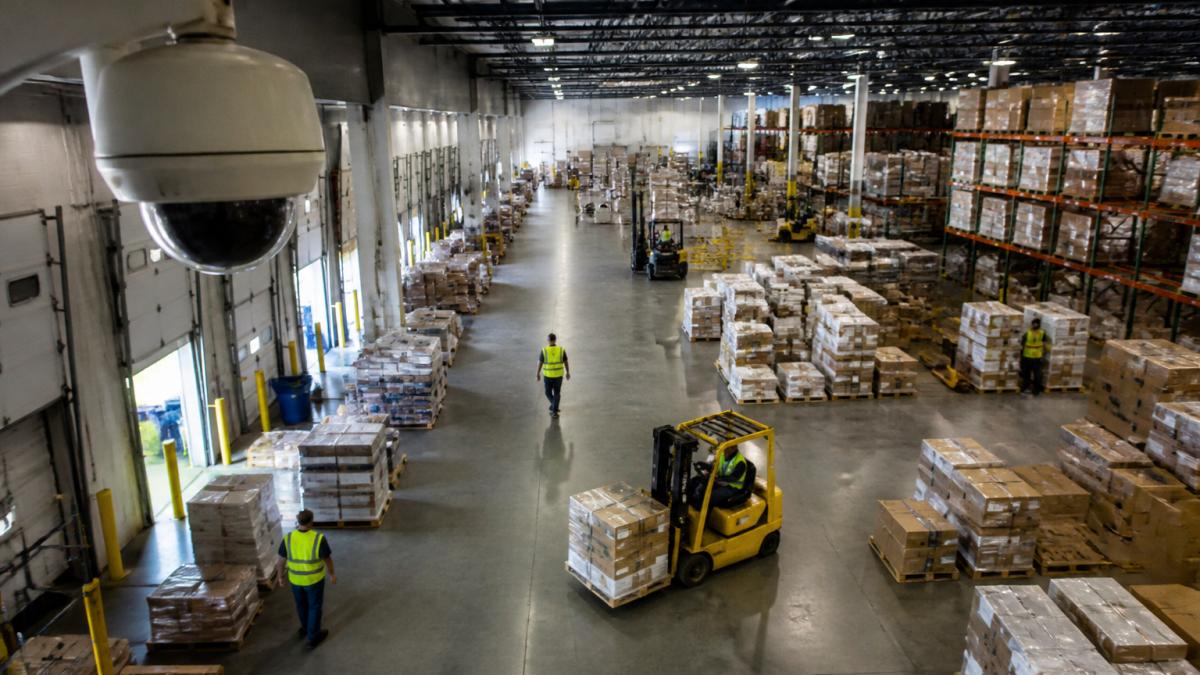
Radar-based sensing complements cameras by detecting movement and proximity in low light or through partial obstructions.
Together they create redundancy: if a camera view is blocked, radar keeps monitoring; if radar can’t classify movement, the camera confirms visually. This layered approach significantly reduces false alarms versus either technology alone.
On-Site Processing vs. Cloud Streaming
This is where the architecture decision matters most.
On-site processing runs the AI directly on servers in your warehouse: video never leaves your building, and alerts transmit immediately to your monitoring station or team.
The practical benefit: your system works during internet outages. A storm knocks out your connection? The on-site server keeps detecting threats and storing verified alerts. When connectivity returns, the system syncs with your monitoring station.
On-site processing also gives you tighter control over camera sensitivity settings. You can adjust detection thresholds per camera to match your specific warehouse layout and reduce false alerts in high-traffic areas.
Warehouse Intrusion Detection and Access Control
Intrusion detection identifies unauthorized people entering restricted zones.
The system also tracks vehicle intrusions: unauthorized vehicles on your property trigger alerts, and you can define which vehicles are allowed. This matters for warehouses with parking areas or outdoor storage.
Integration with your existing access control systems makes this more powerful: the AI cross-references badge data with video to confirm whether an intrusion is a legitimate employee or an actual threat, reducing false positives.
Real-Time Hazard Monitoring: Spills, Obstacles, and Unsafe Behavior
Workplace safety depends on catching hazards before they become injuries. AI video analytics for warehouses detects environmental hazards that create accident risk.
Wet floors and spills are critical, a slip-and-fall can sideline a worker for weeks.
Obstacles left in aisles create collision risks.
The system learns your facility’s normal patterns, distinguishing routine activity from genuinely unsafe situations and reducing alert fatigue compared to rule-based systems that trigger on every minor movement.
Collision Prevention for Forklifts and Autonomous Mobile Robots
Forklift collisions and AMR incidents represent a significant portion of warehouse injuries. AI threat detection for warehouses prevents these through proximity monitoring and behavior prediction.
Radar-based detection tracks the position and velocity of forklifts and AMRs in real time.
The system also detects near-misses, narrowly avoided collisions that often indicate unsafe traffic patterns, inadequate sightlines, or training gaps.
For autonomous mobile robots, the system monitors whether the AMR’s own safety systems are functioning.
Collision prevention systems reduce incident risk but don’t eliminate operator responsibility. Operators must remain attentive and trained. Use the system as a safety layer, not a replacement for proper training and equipment maintenance.
AI Video Analytics for Warehouses: Detection Accuracy and False Alarms
The real measure of any threat detection system is accuracy. A system that triggers hundreds of false alarms becomes worthless because operators stop trusting it. But “accuracy” is not a single number, and most vendor claims collapse under scrutiny because they never define what they measured. Here is how to evaluate a system on your own terms.
The Metrics That Actually Matter
Four numbers determine whether a detection system is usable in a working warehouse:
- Precision, of every alert the system fires, what share is a real threat? Low precision means alert fatigue.
- Recall (detection rate), of every real threat that occurs, what share does the system catch? Low recall means missed incidents.
- False-positive rate, how many non-threats per camera per shift trigger an alert? This is the number operators feel every day.
- Detection latency, the time from event to alert reaching a human. For a forklift near-miss, seconds matter; for an after-hours intrusion, a minute may be fine.
Precision and recall trade off: tighten thresholds to catch more threats and you generate more false alarms; loosen them to quiet the system and you miss real events. The goal is the operating point that matches each zone’s risk.
How Detection Technologies Compare
No single sensor wins on every dimension. A practical comparison across the modalities used in warehouses:
| Technology | Coverage | Low-light performance | Privacy profile | Typical latency | Installation burden |
|---|---|---|---|---|---|
| IP cameras + computer vision | Wide, but line-of-sight only | Degrades in darkness; needs IR or added lighting | Captures identifiable images, highest privacy sensitivity | Sub-second to a few seconds | Leverages existing cameras; may need repositioning |
| Radar / UWB | Wide, works through some obstructions | Unaffected by darkness | No imagery, low privacy sensitivity | Milliseconds | New hardware mounted on vehicles or structure |
| Wearables (tags, vests) | Only where workers wear them | N/A | Tracks individuals, consent and labor considerations | Milliseconds | Per-worker provisioning and compliance |
| Sensor fusion | Widest effective coverage | Best of each input | Depends on whether cameras are in the mix | Milliseconds to seconds | Highest integration effort |
Most practitioners find that fusion, cameras for classification, radar for proximity and low-light reliability, delivers the best precision-to-false-alarm ratio, because each sensor covers the other’s blind spots. The trade-off is integration complexity and cost.
Validating Performance in a Live Warehouse
Vendor benchmarks run in clean labs. Your facility has shrink wrap, glare, dust, and foot traffic. Validate before you commit:
- Run a shadow-mode pilot. Deploy alongside your current process for 30-60 days without acting on alerts. Log every alert and label it real or false.
- Build a labeled test set. Include the events you care about, spills, zone intrusions, forklift proximity, plus normal activity that should not trigger.
- Compute precision and recall on your data, not the vendor’s. Ask for the confusion matrix, not a single accuracy figure.
- Measure latency end-to-end, from event to alert on the monitoring station screen.
- Re-test after any threshold change. Sensitivity tuning shifts the whole curve.
Ask vendors for precision and recall at a stated false-alarm rate, not a standalone “99% accuracy” claim. A single accuracy number hides which errors the system makes, and in safety, a missed forklift is not equivalent to a false spill alert.
Why Configuration Drives the Numbers
Camera placement and angle matter, a camera pointed at a wall sees nothing useful. Lighting affects recognition, and crowded areas create more ambiguity than open spaces.
The audit trail matters too. When an alert fires, you need proof: a timestamp, the camera that detected it, the threat classification, and a confidence score, a record that lets you defend a decision, tune the system, and demonstrate your actual detection rate.
Warehouse Safety Monitoring: Reducing Incident Risk and Injury
The ultimate goal of AI threat detection for warehouses is preventing injuries and losses through early detection and rapid response.
Rapid response also reduces severity: even when incidents can’t be prevented, early detection means an injured worker gets help sooner, fire suppression activates faster, and damage stays contained.
Over time, the data becomes valuable.
Injury prevention also improves your insurance profile and regulatory compliance. OSHA documentation of proactive hazard detection demonstrates you take workplace safety seriously, which can improve your safety record and reduce premiums.
Implementation, Privacy, and Audit Trails
Deploying AI threat detection requires planning across three areas: technical integration, privacy governance, and documentation. Most vendor content stops at “consult your legal team.” That is not a plan. Here is what a defensible deployment looks like.
Technical Integration
Start with your existing infrastructure. A well-designed system works with IP cameras from multiple manufacturers, integrates with your current recorders, and connects to monitoring stations via standard protocols. Implementation typically takes weeks, not months, because you are not ripping out infrastructure.
Plan the site survey before installation. Map camera fields of view against the zones you want to protect, identify blind spots, and confirm lighting at night, a detection system is only as good as its coverage.
Privacy and Data Governance
Processing video of workers raises real obligations. Build a governance framework before the first camera goes live:
- Retention schedule. Decide how long video and alert clips are kept, and enforce automatic deletion. “Keep everything forever” is a liability, not a policy.
- Access controls. Limit who can view live feeds, pull recorded clips, and export footage. Log every access.
- Anonymization. Where full identification is not needed, spill or obstacle detection, for example, consider masking faces or running detection on non-identifiable data.
- Worker consent and notice. Document consent from employees who work on camera. Post clear notice in monitored areas. Some jurisdictions require specific signage or advance notice.
- Labor consultation. In unionized facilities, monitoring changes are often a mandatory subject of bargaining. Involve labor representatives early.
- Vendor data handling. Confirm whether video leaves your facility, where it is stored, and who can access it. On-site processing keeps footage inside your building and simplifies this question considerably.
Workplace monitoring rules vary by state and locality, and some apply specifically to cameras in break areas, restrooms, and locker rooms. Confirm your configuration against the rules that apply to each site before you deploy, do not assume one policy covers a multi-state footprint.
Audit Trails and Accountability
Every alert should be logged with a timestamp, source camera, threat classification, and confidence score, a defensible record if you need to explain why an alert was issued or prove the system was functioning during an incident.
The log should also capture the human side: when an alert was acknowledged, what action was taken, and who decided. That chain of custody is critical if you ever need to present evidence or defend a decision to a regulator.
Incident Response and Alert Workflow
Detection is only half the system. Design the response path deliberately:
- Alert reaches the right person. Route by zone and severity, a spill goes to the floor supervisor, an after-hours intrusion to the monitoring station.
- Escalation rules. If an alert is not acknowledged within a set window, escalate to the next tier automatically.
- Documented corrective action. Log what was done, cleanup completed, operator coached, traffic pattern changed, so the response is auditable.
- Review cadence. Review alert logs weekly to catch false-alarm patterns and tune thresholds.
Document your sensitivity settings and alert thresholds, and keep records of when changes were made and why. This proves you are operating the system thoughtfully, not just accepting defaults, and it is the first thing a regulator or plaintiff’s attorney will ask for.
Frequently Asked Questions
How does AI threat detection work in a warehouse?
AI threat detection uses computer vision and radar-based sensors integrated with existing IP cameras to analyze warehouse activity in real-time. On-site AI servers process video feeds locally, identifying threats like weapons, intruders, unauthorized vehicles, and fire without streaming footage to the cloud. When a threat is detected, the system sends verified alerts directly to your team or monitoring station, reducing false alarms through camera-specific sensitivity tuning.
Can AI threat detection work with existing warehouse cameras?
Yes. AI threat detection systems integrate seamlessly with your current IP camera infrastructure and recorders, eliminating the need for expensive hardware replacement. The on-site AI servers connect to cameras from multiple manufacturers across different locations, analyzing feeds independently. This compatibility means you can deploy AI detection without ripping out infrastructure you already have in place.
What happens to warehouse threat detection if the internet goes down?
On-site AI processing continues to function during internet outages. Real-time threat detection and hazard monitoring operate independently of cloud connectivity, so your warehouse remains protected even when your internet connection fails. Alerts are queued locally and delivered to your team or monitoring station as soon as connectivity is restored, ensuring no critical threats are missed.
How do warehouses reduce false alarms from AI security systems?
Modern AI video analytics for warehouses reduce false alarms through camera-specific sensitivity settings, allowing you to adjust detection thresholds based on each location’s unique layout and activity patterns. Advanced systems use multi-sensor confirmation (combining computer vision with radar data) to verify threats before triggering alerts. This approach minimizes the noise that overwhelms monitoring stations, ensuring your team responds only to genuine threats.