

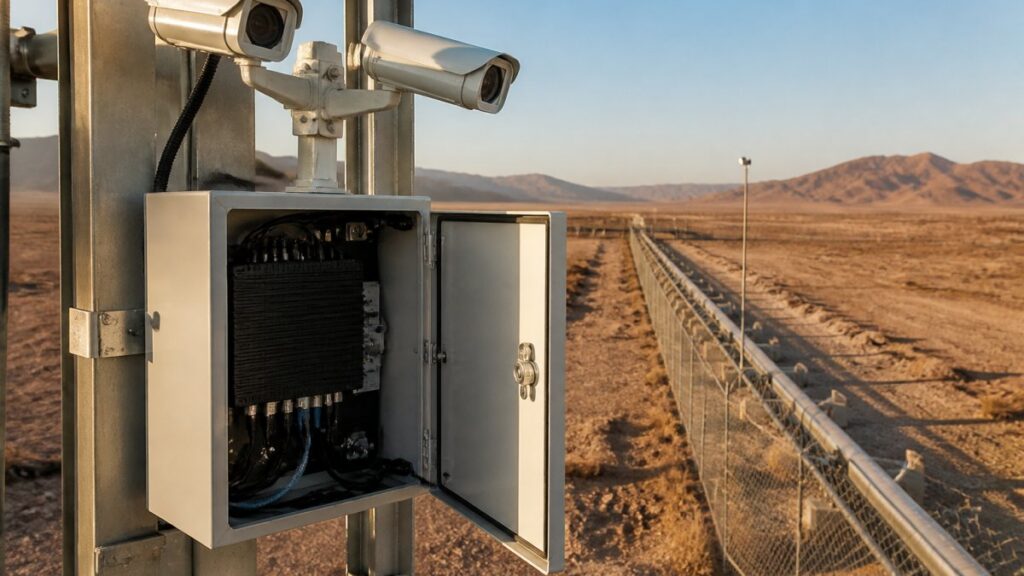
Last Updated: November 2, 2026
Quick Summary
AI security for remote sites works by running detection on-site at the edge, so cameras keep analyzing feeds and recording events even when the internet drops. On-site edge AI is the strongest model for unattended, remote, and regulated sites, and it keeps video local instead of sending it to third-party servers.
- Cloud-only analytics stop the moment the upstream link fails, leaving unattended sites blind.
- MDI AI Detection’s on-site servers integrate with existing IP cameras and recorders, so no replacement is needed.
- Camera-specific sensitivity settings cut nuisance alerts better than a blanket ruleset across sites.
- Size cellular failover for alert metadata and snapshots, not continuous full-resolution video.
- Test detection at one site for 60 to 90 days before committing to a full rollout.
Table of Contents
- Why Remote Site Security Breaks When the Cloud Does
- How On-Site AI Video Analytics Protect Unattended Locations
- Reducing False Alarms With AI at Multi-Site Operations
- AI Security for Critical Infrastructure and Regulated Sites
- Comparing Deployment Models for Remote Site Security
- Operational Metrics That Prove Your Remote Site Security Works
- Book a Demo and Test Detection at One Site First
- Frequently Asked Questions
Why Remote Site Security Breaks When the Cloud Does
Remote site security fails when the network fails. That is the uncomfortable truth behind most cloud-dependent camera systems, and it is the problem ai security for remote sites has to solve first.
Consider the scale of the exposure. Check Point’s AI Security Report 2026 found that one in 17 AI prompts carried serious data-exposure risk, and that organizations run an average of 10 AI applications per month.
The connectivity gap at unattended locations
Most remote sites are not staffed around the clock. A distribution center might have one shift supervisor at 2 a.m.; a substation might have nobody. Cloud video analytics assume a stable upstream connection these locations frequently lack.
The practical result: detection becomes intermittent, and intermittent detection is worse than none, because it trains your team to distrust alerts.
What outage-blind monitoring actually costs
An outage does not just pause analytics. It pauses the entire response chain. Alerts stop reaching your monitoring station, incident timestamps go missing, and evidence lives on a recorder nobody can reach remotely. For a school district or regulated facility, that gap is a liability question as much as a security one.
If you are already dealing with this, our guide on how to keep AI security systems running during internet outages walks through the practical recovery steps.
How On-Site AI Video Analytics Protect Unattended Locations
On-site AI video analytics process camera feeds locally on hardware at the site, so detection continues whether or not the internet is up.
This is the architectural difference that matters. Cloud analytics send frames upstream and wait for a verdict. Edge analytics reach the verdict on site and only transmit the result.
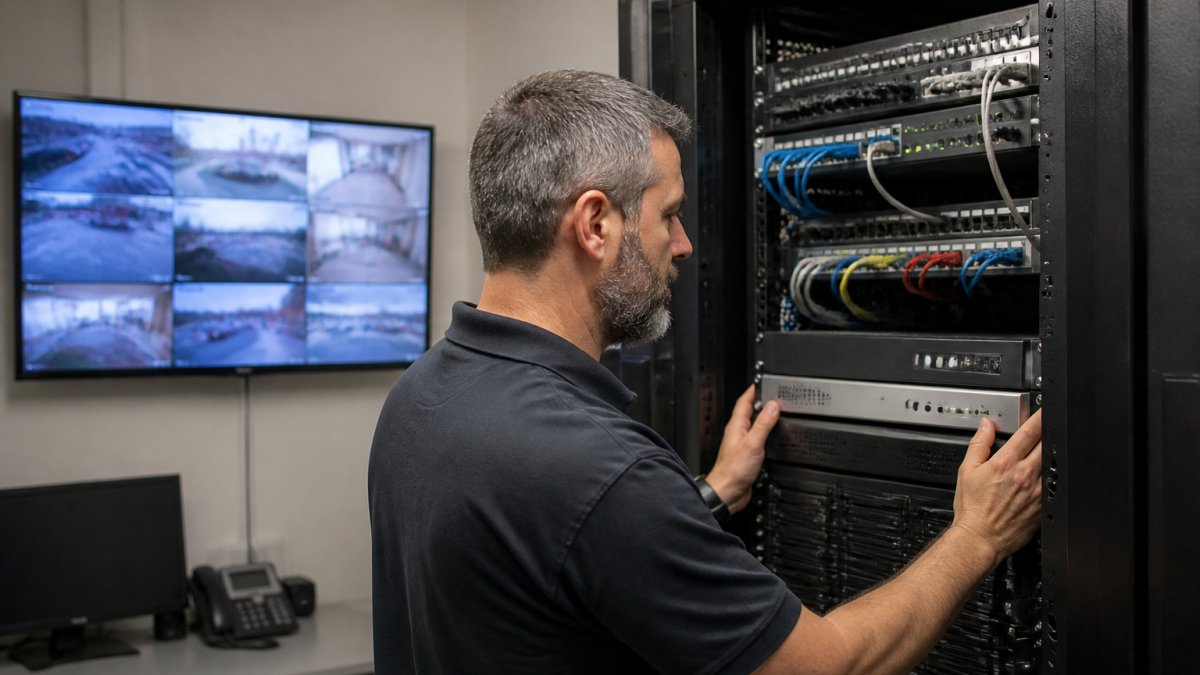
Edge processing on hardware you already own
The cost objection usually arrives right here, and it is fair. Replacing recorders across a dozen sites is a budget conversation nobody wants. The better answer is to leave the infrastructure in place. MDI AI Detection’s on-site servers integrate with existing IP cameras and recorders, so the cameras you installed last year keep working and the AI layer sits alongside them.
For teams mapping out that architecture, the AI video analytics without internet setup guide covers the configuration sequence in detail.
Reducing False Alarms With AI at Multi-Site Operations
False alarms are the quiet killer of multi-site security programs.
That tuning is where most deployments go wrong. A loading dock camera sees constant motion from trucks and staff; a perimeter camera sees almost nothing until someone climbs a fence.
MDI AI Detection supports reducing false alarms through camera-specific sensitivity settings. If nuisance alerts are already overwhelming your station, reducing false alarms from security cameras is the place to start.
AI Security for Critical Infrastructure and Regulated Sites
Regulated environments add a second layer of requirements on top of detection.
The federal guidance is explicit here. Guidance for Securing AI issued by NSA, CISA, and partners states that secure-by-design principles apply to AI systems and that providers of AI components should implement security controls.
A court-ready audit trail with chain of custody answers the evidentiary half of that question.
Physical security integrated with cyber monitoring
At a regulated remote site, the physical and cyber pictures are usually reviewed by different teams on different systems, which is exactly how a coordinated incident slips through. The camera sees a person at the fence while the network sees an unusual login from the site’s management VLAN, and neither team sees both.
Integrating the two does not require a single platform. It requires that the AI security layer emit telemetry the cyber team can consume and that physical events carry enough context for the security operations center:
- Cameras and access control produce door-forced, badge-denied, and tailgating events that should be correlated with video, not reviewed separately.
- Environmental sensors, temperature, water, smoke, power, catch failures that look like nothing on camera but take a site offline.
- Cyber telemetry from the edge appliance itself (login attempts, configuration changes, firmware status) belongs in the same incident record as the physical event, because an attacker who disables analytics is often already inside the network.
An edge appliance that can be reconfigured remotely is also an attack surface. Restrict who can change detection settings, log every configuration change, and treat the appliance’s own cyber hygiene as part of the site’s security posture.
Governance, privacy, and human oversight at the edge
Regulated buyers are increasingly asked not just whether the AI works, but how it decides and who is accountable. Three practices answer that question:
- Data minimization. Keep video and metadata on site where the regulation allows, and send only verified alerts and summaries outward. This reduces both privacy exposure and bandwidth.
- Auditability of model decisions. Every alert should carry the camera, timestamp, model version, and confidence score, so a reviewer can reconstruct why the system flagged an event.
- Escalation to a human operator. AI should verify and prioritize, not arrest or discipline. Define which alert classes route to a monitoring station, which page an on-call manager, and which are logged only.
Operational metrics regulators and auditors ask for
When a regulator or an insurer asks whether the control works, the answer is a metric, not a feature list. Four numbers carry most of the conversation:
- Mean time to detect, the interval between an event and a verified alert, measured at the site, not at the dashboard.
- Mean time to respond, how long from verified alert to a human acknowledging it.
- Site uptime for detection, the percentage of hours the system was actively analyzing, including during connectivity loss.
Comparing Deployment Models for Remote Site Security
Three deployment models dominate, and the right choice depends on site count, connectivity reliability, and evidentiary needs. The decision usually turns on what happens in the first ten minutes after the primary circuit drops, so read the notes under the table before you standardize on one model.
| Model | Detection During Outage | Bandwidth Use | Video Leaves Site | Out-of-Band Recovery | Best For |
|---|---|---|---|---|---|
| Cloud-only analytics | Stops | High | Yes | None, depends on WAN | Staffed sites with redundant fiber |
| Hybrid edge + cloud | Continues locally | Moderate | Partial | Local detection, cloud reporting resumes on reconnect | Mixed portfolios standardizing dashboards |
| On-site edge AI | Continues locally | Low | No | Local console, cellular or secondary link, remote management | Unattended, remote, regulated sites |
Cloud-only is the simplest to deploy and the weakest under failure. It works for staffed locations with redundant connectivity, but at an unattended site the analytics stop the moment the upstream link does, with no local path to recover visibility until the circuit returns.
Hybrid runs detection at the edge while pushing summaries to a cloud dashboard.
On-site edge AI keeps detection, video, and audit records local. Hardening these local pathways often requires evaluating remote site connectivity alternatives that bypass the limitations of standard public infrastructure.
Site-specific threat models change the answer
Treating every remote location as one category is the most common architecture mistake. A retail branch, warehouse, clinic, utility substation, and temporary construction site fail differently and are attacked differently.
- Retail branches face after-hours intrusion, loitering, and internal shrinkage. Cameras are usually already installed and the recorder is in a back office; the priority is keeping detection alive when the store’s broadband drops and pushing verified alerts to a central station.
- Warehouses and distribution centers have high-motion loading docks and large perimeter fences. The threat model is perimeter breach and trailer theft, and the tuning problem is separating normal truck traffic from a person climbing a fence at 2 a.m.
- Clinics and regulated facilities add privacy and audit requirements. Video often cannot leave the site, which pushes the architecture toward on-site edge AI with local retention and a chain-of-custody record.
A single deployment model can serve all five, but only if the edge appliance is specified for the worst connectivity case in the portfolio, not the average one.
Connectivity loss and out-of-band recovery
The failure that matters most is not a camera going down; it is the site losing its primary network connection while everything else keeps running. In that window, cloud-dependent systems go dark, and the response chain stops with them.
A resilient remote-site design assumes the primary link will fail and plans a second path:
- Local detection stays on. Edge analytics continue to analyze feeds and record events on site, so the detection timeline has no gap.
- A secondary link carries alerts. Cellular failover is the usual choice. It has latency and bandwidth ceilings, so configure the appliance to send verified alerts and metadata rather than full-resolution video over the metered link.
- Remote management reaches the site out-of-band. A separate management path, cellular router, serial console, or a VPN that does not depend on the primary circuit, lets an operator confirm the appliance is healthy and pull evidence without dispatching a technician.
- The audit trail closes locally. Events recorded during the outage are timestamped and stored on site, then reconciled when the primary link returns, so the record has no unexplained gap.
Size the cellular failover plan for alert metadata and snapshots, not continuous video. Streaming full-resolution footage over a metered link is the fastest way to blow a data budget and still miss the event.
Weighing the capital outlay? Read our cost-benefit analysis of on-premise AI security servers before you decide.
Operational Metrics That Prove Your Remote Site Security Works
A security program you cannot measure is one you cannot defend in a budget review. Four metrics tell you whether ai security for remote sites is actually delivering.
- Mean time to detect: how long between an event and a verified alert. Edge processing compresses this because detection does not wait on a network round trip.
- False alarm rate per camera: track it monthly. A rising rate signals a camera that needs retuning, not a model that needs replacing.
- Site uptime for detection: the percentage of hours the system was actively analyzing. This is the metric cloud-only deployments fail on during outages.
Book a Demo and Test Detection at One Site First
Rolling AI detection across a portfolio before proving it at one location is how security budgets get wasted.
MDI AI Detection was built by security integrators, and we have installed and supported these systems since 2008.
Ready to see it on your own cameras? Contact our team to book a demo and test detection at one site before you commit to the full rollout.
Frequently Asked Questions
How does AI improve security for remote sites?
AI watches every camera feed continuously and flags specific events, such as a person crossing a perimeter line, a vehicle entering after hours, or a weapon in view. Because detection happens on site, alerts do not have to wait on a cloud round trip. The practical gain is coverage without constant video wall monitoring.
Can AI security systems function without an internet connection?
On-site systems can. When AI processing runs on a local server, cameras and recorders keep feeding it video during an outage, and the server keeps detecting threats and logging events. Alerts queue locally and send when the link returns. Cloud-only platforms cannot do this because the analytics live off site. Ask any provider where the inference runs before you buy, since that single answer decides whether your remote site security survives a fiber cut.
What are the benefits of on-site AI processing for remote locations?
Three stand out. First, no video leaves the building for analytics, which reduces bandwidth needs and data-exposure risk from streaming footage to a third party. Second, detection continues during internet outages, so a failed connection does not blind the site. Third, camera-specific sensitivity settings help reduce false alarms. For remote site security, uptime of detection matters more than the size of the feature list.
Is AI security cost-effective for remote infrastructure?
It usually comes down to what you avoid replacing. On-site AI that runs on existing IP cameras and recorders skips a hardware refresh, and fewer false alarms means fewer dispatch costs and less operator time per shift. Pricing depends on quantity, dates, and delivery, so request a quote from MDI AI Detection for current prices. Compare the total against current monitoring spend and false-alarm dispatches across all locations before deciding.
