

Quick Summary
Yes, you can reduce security monitoring labor costs without losing coverage by first measuring a fully loaded hourly rate and cost per post, then comparing alternatives site by site. Off-hours coverage often carries the highest costs, so review those shifts first. Re-check coverage before cutting any guards.
- Build a fully loaded hourly rate using payroll taxes, insurance, benefits and supervision, not just base wage.
- Calculate annual straight-time cost per post as fully loaded rate x scheduled hours per week x 52.
- Labor costs rise fastest on nights, weekends and holidays, where pay rates are usually highest.
- Route alerts through a three-tier triage workflow so only high-confidence events go to live operators.
- Include monitoring labor, escalation and maintenance when comparing options, or savings will look larger than they are.
Table of Contents
- Where Security Monitoring Labor Costs Come From
- Building a Labor-Cost Baseline and Savings Calculator
- How to Reduce False Alarms From Security Cameras
- Remote Video Monitoring vs. Traditional Security: Where Each Fits
- Cutting Security Guard Overtime Through Scheduling and Automation
- Calculating AI Security Monitoring ROI and Measuring Outcomes
- Booking a Demo to Test Labor Savings at Your Sites
- Frequently Asked Questions
Where Security Monitoring Labor Costs Come From
Security monitoring labor costs can be a significant part of a physical security budget. Costs may include staffing coverage and overtime.
Staffing, overtime and off-hours coverage
Labor costs rise fastest where coverage is thinnest. Nights, weekends and holidays usually carry the highest pay rates, and that is where many organizations lose money without noticing. The U.S. Bureau of Labor Statistics reported that total civilian-worker compensation rose 3.4% over the year through June 2026, according to its Employment Cost Index, which tracks wage and benefit trends across the economy. That steady climb means every extra hour of guarding costs a little more each year.
Off-hours coverage can add staffing demands. A single post that runs around the clock needs coverage across shifts.
Watch out: cutting guards without re-checking coverage can leave a site exposed during the hours that matter most.
Building a Labor-Cost Baseline and Savings Calculator
You cannot cut what you have not measured, and most organizations measure security labor with a single invoice line rather than a cost model. The goal of this section is to give you a defensible baseline you can defend to a CFO, then a calculator you can run site by site before you change a single shift.
Step 1: Build a fully loaded hourly rate
Start with the wage you actually pay, not the posted rate. A fully loaded guard hour may include:
- Base hourly wage
- Payroll taxes
- Insurance
- Benefits and paid time off
- Supervision and scheduling
Use your own payroll and insurance records to estimate your fully loaded rate.
Step 2: Calculate cost per post, per shift, and per site
For each post, record:
- Hours per week the post is staffed
- Overtime hours per pay period
- Fully loaded hourly rate
Then apply:
- Annual straight-time cost per post = fully loaded rate x scheduled hours per week x 52
Step 3: Calculate cost per monitored event
Divide total annual monitoring labor cost by the number of events your team actually responds to in a year. This gives you a cost per monitored event to use in your analysis.
Step 4: Project the alternative
For a remote or AI-assisted monitoring option, build the projected cost from:
- Hardware and installation
- Connectivity and software licensing
- Monitoring labor for alert review and escalation
- Maintenance, support, and training
Pricing depends on the provider and configuration, so request a quote for your specific sites rather than relying on a general figure.
Step 5: Run the savings math
- Annual savings per site = current fully loaded cost minus projected monitoring cost
- Payback period = one-time implementation cost divided by annual savings
- Savings per monitored event = current cost per event minus projected cost per event
Run the math site by site. Some locations may justify keeping on-site guards based on their needs. Consider coverage requirements as you evaluate options.
Build the calculator in a spreadsheet with one row per post and one column per assumption. When a number is uncertain, use a range rather than a single figure, and show the low, mid, and high savings case to decision-makers.
Do not compare a fully loaded guard rate against a bare monitoring subscription price. Include monitoring labor, escalation handling, and maintenance on the monitoring side, or the savings will look larger than they are.
::: True financial transparency requires applying this same rigorous accounting to the broader technical environment, where reducing infrastructure costs often reveals hidden operational inefficiencies that mirror the complexities of security staffing.
The steps below summarise how to build a defensible labor-cost baseline and savings calculator before changing any shifts.
| Step | What to do | Note |
|---|---|---|
| 1. Build a fully loaded hourly rate | Add base wage, payroll taxes, insurance, benefits, and supervision | Use your own payroll and insurance records |
| 2. Calculate cost per post | Fully loaded rate x scheduled hours per week x 52 | Record overtime hours per pay period |
| 3. Calculate cost per monitored event | Divide annual monitoring labor cost by events responded to | Gives a cost per event for analysis |
| 4. Project the alternative | Include hardware, connectivity, monitoring labor, and maintenance | Request a quote for specific sites |
| 5. Run the savings math | Subtract projected cost from current cost per site | Show low, mid, and high savings cases |
How to Reduce False Alarms From Security Cameras
False alarms can add work to security monitoring. Nuisance alerts may require operator review and affect trust in the system. Alarm triage is one approach to managing monitoring workload.
Why false alarms cost more than they appear to
False alerts may require operator attention and review. The potential effects to consider include:
- Operator time spent reviewing alerts
- Cost per monitored event
Tune detection per camera, not per system
Camera-specific sensitivity settings can be configured based on the scene.
Build a three-tier triage workflow
Route alerts by confidence and consequence rather than sending everything to an operator:
- Tier 1, Immediate operator review: high-confidence events in restricted zones, after-hours person detection, door or gate alarms. These go to a live operator with a defined response window.
- Tier 2, Review queue: lower-confidence events, perimeter motion without classification, or events during business hours. These are reviewed in batches, not in real time.
- Tier 3, Log only: events that are informational, such as a vehicle passing a public-facing camera. These are retained for audit but do not consume operator time.
Define escalation paths in writing
Organizations can document their own escalation procedures for alerts.
Measure triage performance
Organizations can track alert and response metrics and compare them with a baseline.
The goal is to manage alerts while maintaining appropriate coverage.
Remote Video Monitoring vs. Traditional Security: Where Each Fits
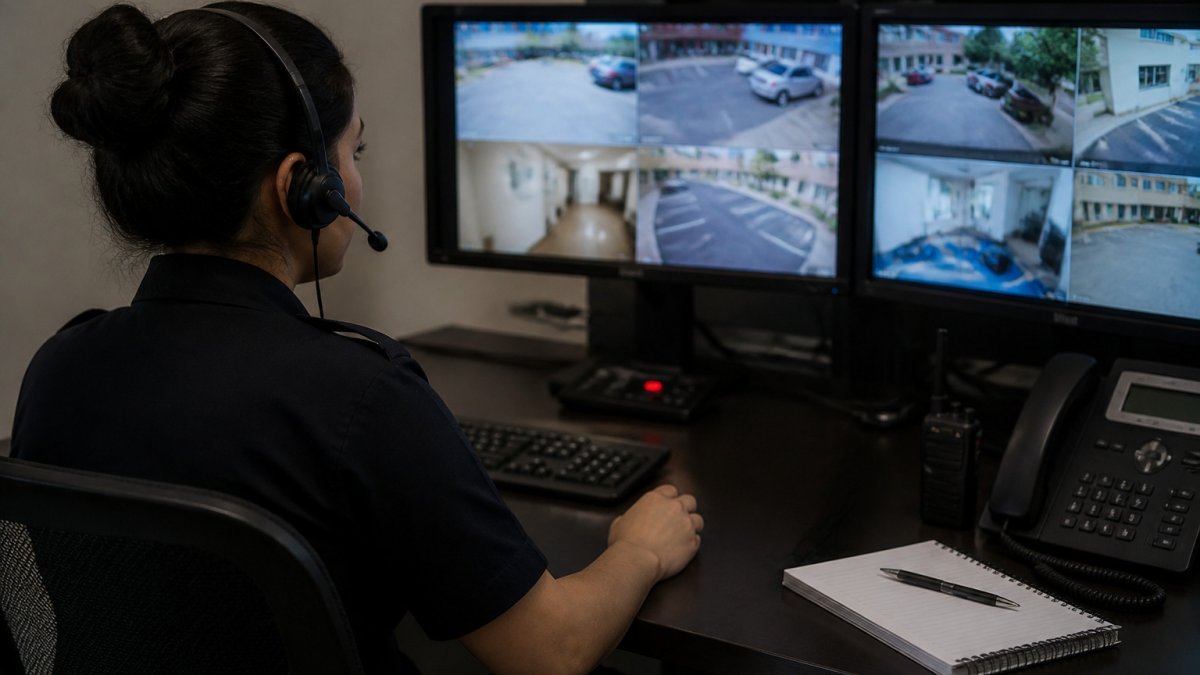
Traditional guarding involves people physically present at a site. Remote video monitoring uses cameras and may involve operators reviewing alerts from a central location. The appropriate approach depends on the site’s needs. The Security Guard Workforce in the United States report from the UC Berkeley Labor Center describes how the guard workforce is structured, which helps when weighing staffing options.
For a deeper look at whether proactive monitoring fits your operation, see is proactive video monitoring worth it for your business. Teams that want to see the range of sites this approach covers can review how MDI protects construction yards, dealerships, self storage and retail with AI on existing cameras.
Cutting Security Guard Overtime Through Scheduling and Automation
Review schedules alongside incident patterns when evaluating staffing needs.
Accurate time records can help organizations review labor costs.
Automation can take over repetitive checks. Scheduled camera sweeps and automated zone monitoring free operators to focus on verified events. A TEAM Software guide to reducing security guard expenses recommends electronic timekeeping and overtime control as core cost measures, which fits this approach.
Even with automation, avoid cutting coverage below what your risk assessment requires.
Calculating AI Security Monitoring ROI and Measuring Outcomes
ROI analysis can compare potential savings against system costs. Consider labor, installation, and ongoing support in the calculation.
Organizations can track detection and response metrics and compare them with a baseline.
For a step-by-step method, see AI video detection ROI calculation: a step-by-step guide. A companion guide on calculating real savings from AI video surveillance walks through the same math with additional examples.
Industry guidance also suggests that safety and cost management belong together. OSHA’s safety management guidance notes that strong safety programs can prevent injuries and improve compliance, which supports keeping protection strong while trimming costs.
Booking a Demo to Test Labor Savings at Your Sites
You can evaluate potential labor savings using your own site data.
MDI AI Detection works with existing IP cameras and recorders, runs AI on-site so detection continues during internet outages, and sends verified alerts to your team or monitoring station through Immix and Bold Manitou. The system includes camera-specific sensitivity settings and keeps a court-ready audit trail.
Book a demo to see how the system works with your current equipment and to review a labor-savings estimate for your sites. Pricing depends on quantity and service needs, so request a quote for your operation.
Frequently Asked Questions
How can businesses reduce security monitoring labor costs?
Potential areas to review include false alarms, monitoring hours, overtime and alarm dispositions per site. Compare your own data before making changes across the portfolio.
Can reducing false alarms lower security staffing costs?
Reducing false alarms may reduce the time spent reviewing alerts. MDI AI Detection offers camera-specific sensitivity settings and real-time detection of weapons, intruders, vehicles and fire. The effect on staffing costs depends on your operation.
How do you calculate the ROI of AI security monitoring?
Start with a baseline: monitoring hours per site, overtime hours, and alarm dispositions. Compare your own data with the system’s costs to assess potential ROI. Pricing depends on quantity and configuration, so request a quote for your specific needs.
Is on-site AI video monitoring less expensive than cloud-based monitoring?
MDI AI Detection processes video on-site, does not stream video to third-party clouds, and continues detection during internet outages. Compare costs for your specific configuration, including any hardware or licensing costs, rather than relying on a general comparison.
